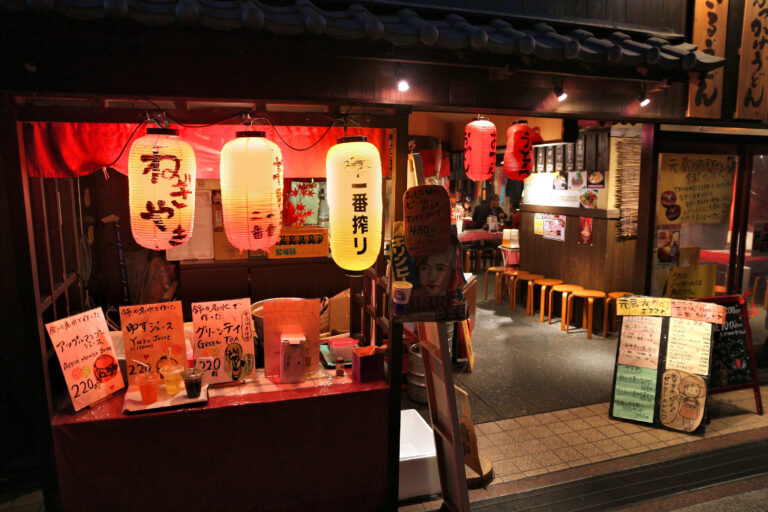
In this post, we will be learning all about the vibrant Japanese bars known as izakaya. If you’re planning a trip to Japan, a trip to an izakaya should definitely make your list!
What is an izakaya?
Izakaya (居酒屋 / いざかや) literally translates to something along the lines of ‘a shop to reside and drink’.
They are often compared to Spanish tapas bars, in that it is custom to order multiple smaller food dishes for the table to share rather than each person ordering a starter, main course and dessert.
They could be described as a middle ground between a restaurant and a bar.
Izakaya are uniquely Japanese and have a specific vibe you just must experience first hand!
You can find tiny little cramped izakaya tucked away in alleys, or fancier, high end bars that you need to reserve weeks in advance.

That being said, you won’t have trouble finding an everyday, casual izakaya in just about any area you find yourself wandering around.
They are popular hangout spots for university students, work colleagues, friends and family. Remember that as izakaya are bars at the end of the day. To have an alcoholic beverage you must be at the legal drinking age in Japan, 20 years old. Therefore, not all establishments are suitable for families with children.

Popular chain izakaya would likely allow families with children, at least before a certain time, but make sure to check beforehand.
If you plan on going out to drink at an izakaya while in Japan, check out our other post about drinking culture to familiarise yourself with how the Japanese have a good time!
What do izakaya serve?
Izakaya often have an extensive menu of drinks. There are of course non-alcoholic beverages available such as soft drinks and Japanese teas. Japanese teas are even popular as mixers for alcoholic beverages!
While the standard drinks like beer and wine are available, izakaya are known for their highballs and chuhai cocktails (also known as ‘sours’).
A highball consists of whiskey, soda, lemon and ice, while a chūhai (チューハイ) is essentially a highball made with shōchū (焼酎 / しょうちゅう; a Japanese spirit distilled from grains or vegetables) rather than whiskey.

These cocktails can be made from a range of mixers from classic fruity flavours like peach or grape, to tea-based mixers such as oolong or jasmine.
As for food, most izakaya have the standard Japanese bar menu, including small dishes like edamame, gyoza, chicken skewers (yakitori) and fried chicken (karaage) to bigger dishes like yakisoba and rice bowls (donburi) and even sashimi and sushi!
It’s typical to order several dishes to share with your companions, and you can keep ordering additional dishes throughout your visit.

How to visit an izakaya and what to expect
Visiting a traditional bar for the first time in a country you may not know the language can be a bit of a daunting idea. But an izakaya is the perfect place to take on this challenge!
The staff are really hospitable, and will welcome you with a warm, loud irrasshaimase greeting upon entering the establishment.
Once you settle your nerves with a delicious cold drink accompanied with a delicious side dish, you can fully enjoy the lively, unpretentious atmosphere.
After the warm welcome greeting, the host will then ask nan mei sama desu ka? (何名様ですか / なんめいさまですか) meaning ‘how many people?’
You can simply use your fingers to indicate the size of your party, but if you want to flaunt your Japanese skills, take a look at the table below for counting people!
| English | Kanji | Hiragana | Romaji |
| One person | 一人 | ひとり | hitori |
| Two people | 二人 | ふたり | futari |
| Three people | 三人 | さんにん | sannin |
| Four people | 四人 | よにん | yonin |
| Five people | 五人 | ごにん | gonin |
| Six people | 六人 | ろくにん | rokunin |
| Seven people | 七人 | ななにん | nananin |
| Eight people | 八人 | はちにん | hachinin |
| Nine people | 九人 | きゅうにん | kyuunin |
| Ten people | 十人 | じゅうにん | jyuunin |
Most izakaya offer ‘all-you-can-drink’, 飲み放題 / のみほうだい) and ‘all-you-can-eat’ (食べ放題 / たべほうだい) menus. These are usually a set price for a set time period wherein you can order anything from a select menu of food and drinks!
Things to note:
- Some establishments’ menus are in handwritten Japanese. It’s beautiful to look at but can be quite difficult to decipher. Luckily, many places will provide an English menu and if not you can use the handy photo translate feature on the Google Translate app. The more up-to-date izakaya have tablets where you can scroll through the menu and place your own order. It’s even becoming increasingly common to order through your own phone via a QR code on the table.

- Before dining at an izakaya it is important to be aware of the otooshidai (お通し代 / おとおしだい) or sekiryou (席料 / せきりょう) which as essential a ‘table charge’. On average it would probably be about 300 yen per person. Otoushi actually means ‘appetizer’ so in exchange for this fee the restaurant will provide a little starter dish such as tofu or a side salad. It is not custom to accept tips in Japan so in a way this is in lieu of that.
- While indoor smoking bans have come into effect since 2020, a lot of izakaya may still offer indoor smoking facilities. You can sit at a non-smoking seat by requesting a kinen seki (禁煙席 / きんえんせき). On the other hand, if you would like to smoke indoors your can ask for a ‘smoking seat’ or kitsuen seki (喫煙席 / きつえんせき). These seats are usually located in a separate part of the restaurant.
Essential izakaya vocabulary
| English | Kanji | Hiragana | Romaji |
| Izakaya | 居酒屋 | いざかや | izakaya |
| Reservation | 要約 | ようやく | youyaku |
| Drinks | 飲み物 | のみもの | nomimono |
| Food | 食べ物 | たべもの | tabemono |
| All-you-can-drink | 飲み放題 | のみほうだい | nomihoudai |
| All-you-can-eat | 食べ放題 | たべほうだい | tabehoudai |
| Menu | メニュー | めにゅー | menyuu |
| Recommendation | おすすめ | おすすめ | osusume |
| Sold out | 売り切り | うりきり | urikiri |
| Excuse me | すみません | すみません | sumimasen |
| I’ll have the … | …ください | …ください | …kudasai |
| Appetizer | お通し | おとおし | otooshi |
| Cover charge | 席料 | せきりょう | sekiryou |
| Cheers | 乾杯 | かんぱい | kanpai |
| Bill / check | お会計 | おかいけい | okaikei |
| Credit card | カード | かーど | kaado |
| Cash | 現金 | げんきん | genkin |
| Thank you for the meal | ご馳走様でした | ごちそうさまでした | gochisousama deshita |
If you haven’t yet, do have a read of our blog post on useful Japanese restaurant phrases and vocabulary. It will definitely help you out on your izakaya outing and there are printable cheat sheets you can take with you too!
Related posts
- What to Expect at a Traditional Japanese Ryokan
- What to Expect at a Japanese Tea Ceremony (Etiquette + Key Vocabulary)
- What to Expect at a Japanese Summer Festival
JapanesePod101 is our top recommendation to learn Japanese online. We love the fun, current audio lessons and interactive online tools. Sign up for your free lifetime account and see for yourself!

Hannah is a half Irish/half Japanese girl living in Ireland. Her love for Japan and the Japanese language led her to studying languages and translation in university where she specialised in Japanese. She spent a year studying abroad at Rikkyo University in Tokyo. In her free time, Hannah enjoys using her sewing machine to upcycle clothes and create new pieces!