In our previous post, we discussed the customs and habits to know when visiting a Japanese home, from taking off your shoes to bringing a small gift.
Now we will learn what to actually say during your visit!
Like the customs mentioned before, it is not that these phrases are necessary in order to make you the ‘perfect’ guest, but rather that they help give you some insight into an authentic Japanese home visit experience!

Learn the essential Japanese you need for your trip with this FREE Absolute Beginner course. Start with simple greetings, useful phrases and everyday Japanese, even if you've never studied Japanese before.
Entering the home
O jama shimasu
お邪魔します
Please excuse the intrusion
O jama shimasu (お邪魔します / おじゃまします) is the first phrase you say when entering someone’s home.
Jama (邪魔) translates as ‘hindrance’ or ‘disturbance’, so literally the phrase means something like ‘I’m making a disturbance!’
Although this sounds odd in English, in Japanese it’s a set phrase and polite expression, used to express the sentiment ‘I’m coming in!’
In this way you are acknowledging that you are a guest in the home and respectfully entering into their private space.

Shitsurei shimasu
失礼します
Excuse me
Shitsurei shimasu (失礼します / しつれいします) is quite similar to the previous expression.
Shitsurei (失礼) translates as ‘discourtesy’ or ‘impoliteness’. Literally translated it would be ‘I’m being impolite’, though the nuance is more ‘excuse me’.
While o jama shimasu is more particular to entering someone’s space or home, shitsurei shimasu is a broader term for ‘excuse me‘ which can be used for a range of situations such as when interrupting or leaning over someone, or excusing yourself from your boss’s office.
Suteki na o uchi desu ne
素敵なお家ですね
What a lovely home you have
It’s likely that your host would have tidied up their home a bit in anticipation for your visit, so the compliment suteki na o uchi desu ne (素敵なお家ですね / すてきなおうちですね) would go a long way!
Suteki (素敵) means ‘lovely’, ‘charming’, ‘superb’ etc and o uchi (お家) is ‘home’.
Gift giving
Tsumaranai mono desu ga…
つまらないものですが
It’s not much, but…
If you have brought a little offering for your host, you can say tsumaranai mono desu ga (つまらないものですが). Directly translated it admittedly sounds a bit dramatic: ‘it’s a boring/trivial thing but…’. It’s also not a full sentence as you trail off what seems mid way.
However, none of this matters in this context, as this is pretty much a set phrase for use when giving someone a gift.
As we’ve seen with the first two phrases, the nuance in Japanese differs from its literal meaning. It’s an example of Japanese polite, humble language where the speaker downplays what they are giving.
It’s similar to how we might say in English, ‘it’s just something small’ when giving a gift. You’re not actually saying that the gift is small or boring, you’re just being modest about it.

Douzo
どうぞ
Here you go
Douzo (どうぞ) is a great word to know. You can use it by itself while physically handing over the gift, to express ‘please, accept it’.
You can also use it to finish the expression above that trails off. So you can say tsumaranai mono desu ga, douzo. The tsumaranai phrase humbles the gift, while douzo is the actual offering of it.
As a side note, douzo can also be useful in offering food to someone, inviting them to enter somewhere or to go ahead of you.
During your visit
Itadakimasu & gochisousama deshita
いただきます & ご馳走様でした
Thank you for the food (before & after)
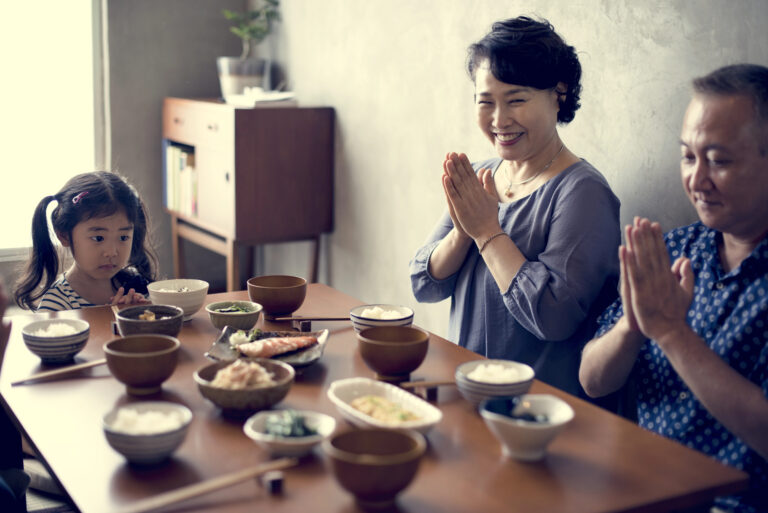
Itadakimasu (いただきます) is said before tucking into a meal, snack or drink. Strictly speaking, it means ‘to humbly receive’.
Gochisousama deshita (ご馳走様でした / ごちそうさまでした) translates to something along the lines of ‘it was a great treat’, so this phrase is used after finishing the meal/drink.
Again, no need to focus too much on the literal meanings, as at the end of the day, both phrases are used to show gratitude for the food your host has prepared for you!
Oishii desu
美味しいです
It’s delicious!
Oishii desu (美味しいです / おいしいです) means ‘delicious’ or ‘tasty’ in Japanese.
As I said, compliments go a long way, so after tucking into some carefully prepared snacks or drinks by your host, be sure to let them know that their efforts paid off!
Onaka ga ippai desu
お腹がいっぱいです
I’m full
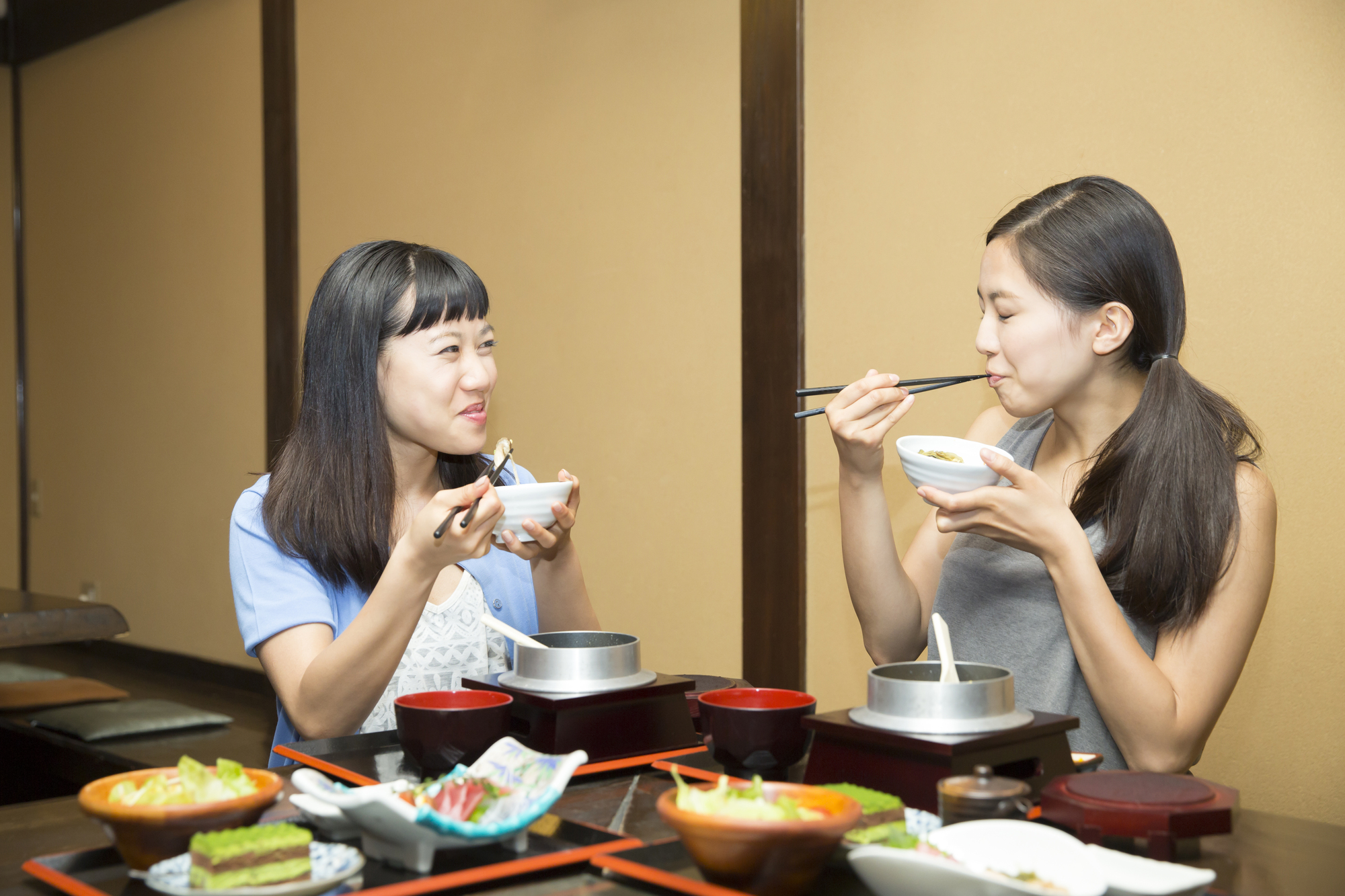
We’ve all been there, you’ve already had a starter, main and dessert provided by your host and out of hospitality they are offering you even more food which might just make you explode.
Onaka ga ippai desu (お腹がいっぱいです / おなかがいっぱいです) is a polite way to decline any more offerings. Onaka means ‘stomach’ while ippai means ‘full’.
Toire / o te arai wa doko desu ka?
トイレ / お手洗いはどこですか
Where is the toilet / washroom?
If you want to use the toilet or to wash up upon arrival, or before or after eating, you can ask toire wa doki desu ka? (トイレはどこですか / といれらいはどこですか). Toire is of course ‘toilet’ and doko is the question word ‘where’?
You can also use the word te arai (手洗い / てあらい), which translates to something like ‘washroom’.
Soro soro kaerimasu
そろそろ帰ります
It’s about time to get going
If you read our last post, you will remember that it’s important to read the room and understand the natural ending to your visit.
You don’t want to cut the stay short, seeing as the host went through the trouble to prepare their abode for you. Of course, you also don’t want to overstay your welcome.
That being said, this ‘natural time’ depends on many factors: your closeness, schedules, whether other people live in the house…
The host isn’t likely to kick you out, so when you feel your visit coming to an end, you can say soro soro kaerimasu (そろそろ帰ります / そろそろかえります). Kaerimasu is the polite verb ‘to go home’ and soro soro is an onomatopoeic adverb to mean ‘about time’ or ‘before long’.
Learn the essential Japanese you need for your trip with this FREE Absolute Beginner course. Start with simple greetings, useful phrases and everyday Japanese, even if you've never studied Japanese before.
Related posts
- 14+ Basic Japanese Greetings You’ll Use Every Day
- 30+ Basic Japanese Phrases for Travelers to Japan
- Visiting a Japanese Home? Essential Etiquette You Need to Know!
📌Pin this for later

Hannah is a half Irish/half Japanese girl living in Ireland. Her love for Japan and the Japanese language led her to studying languages and translation in university where she specialised in Japanese. She spent a year studying abroad at Rikkyo University in Tokyo. In her free time, Hannah enjoys using her sewing machine to upcycle clothes and create new pieces!