
Readers, you know I am a HUGE fan of learning Japanese through immersion.
When you are enjoying a Japanese TV show or a movie that you love, you absorb new language much more easily than studying from a book. And it doesn’t even feel like learning!
Lingopie is a platform that will help you learn Japanese through binge watching real Japanese TV shows and movies. It’s basically Netflix for language learning.
You can watch authentic, native Japanese content in a huge range of genres.
Each video has optional subtitles in Japanese and English. You can click on a word you don’t know to get a definition. New words are also added to your flashcard deck to review later.
I first reviewed Lingopie in 2022, when Japanese was newly added to the platform and still had several bugs.
I’m happy to report that they have made HUGE improvements to the Japanese offering since then, with a very full catalogue of Japanese content and lots of new features!
Here’s my honest review of Lingopie to learn Japanese:
Lingopie Japanese review summary
| URL | https://lingopie.com/ |
| Price | $6.99-$13.99/month, depending on plan. Plus we have an exclusive Team Japanese discount! |
| Access | Website, iOS app, Android app, smart TV apps |
| Summary | Learn Japanese watching real shows with clickable subtitles for instant translations. |
| Verdict | A fun and affordable way to improve Japanese listening and vocabulary. Recommended for those who already know some Japanese and want to increase their exposure to native content. |
Learning Japanese with Lingopie
It is really easy to get started with Lingopie. Firstly, they offer a 7 day free trial (click here to sign up).
When you sign up for the trial you will answer a few quick questions about your level, your reason for learning, and your preferred genres.

Then you are instantly given three options of shows you might enjoy and you can dive right in!
Lingopie Japanese content
Lingopie has Japanese content in a wide range of genres. There are dramas, anime, documentaries, cooking shows, music, movies and more.
There is also a kids section – really useful if you’re learning Japanese as a family.

In particular, Lingopie have a good selection of Japanese dramas and also documentaries about life in Japan/Japanese culture.
I would describe most of the content as ‘hidden gems’. They might not have all of the same big names as certain other platforms, but it is still good quality content.
They also have several Disney movies in Japanese!
In most cases, you get access to full series – so you can actually get stuck into a series and get several hours of listening time just on that one show!
This is a big improvement from when they launched, and from other platforms I have tried, where you just get random sample episodes.
The layout of the homepage is loosely similar to Netflix, with suggested shows grouped by genre/theme. There is quite a lot going on, but if you use Netflix you will probably find it easy to navigate.
How to use the subtitles on Lingopie
The main draw of Lingopie is the interactive subtitles!
With Lingopie’s special subtitles, you can read along with the audio, and click on any word you don’t know for an instant translation.
Any word you look up is automatically added to your words list and flashcard deck so you can review it later.
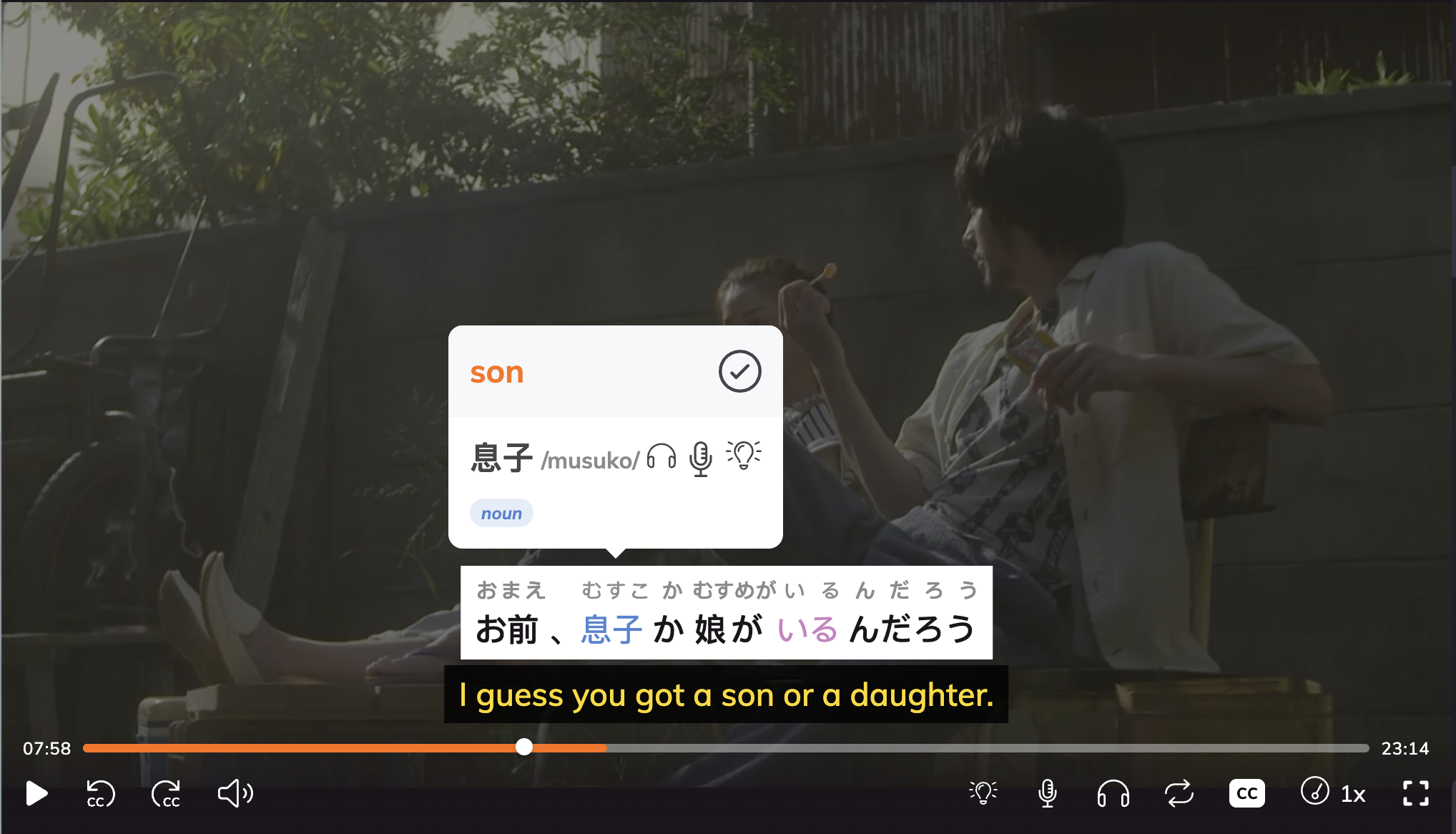
You can turn on the subtitles at the bottom of the video. These are available in Japanese and/or English.
You can also have the full script showing on the right side of the screen. This is in Japanese only. You can click on each line to play it, or simply follow along with the video.

You can turn off the subtitles and the script completely if you want to really test your listening skills.
When I first tried Lingopie a few years ago, my main issue was that the Japanese subtitles were kanji-only, which made it inaccessible for beginners.
Japanese subtitles are now much, much better. You can have your subtitles in English, full Japanese (with kanji), and then depending on your Japanese reading ability you may choose to add furigana (hiragana) or romaji (English phonetic letters) to help you read the Japanese.
Just click on CC at the bottom right of the watch screen and from there you can easily toggle your selection on and off.

The auto-pause feature is also great. It pauses after each subtitle so you actually have time to read it and look up words.
I don’t use it all the time (sometimes you need to just watch and get into the flow) but it’s great for more active study sessions.
My main problem now with Lingopie is that there is sometimes an issue where the translations break down sentences strangely. For example, it sometimes combines a particle with a word, and will save that combo in your vocab list. Or it will present two or more words together as a set phrase, where it would be more useful to break it down further into individual words.
If you are an intermediate learner you will be able to spot and understand what’s happening here. But if you are a beginner, this could be quite misleading.
Anyway, other features do I like: you can easily adjust the speed if it’s too fast for you.

When you click on a word you get a basic definition, but you can also click on the lightbulb symbol for a more detailed explanation.
The detailed explanations are AI-generated so occasionally they are a little odd, but overall I found them helpful.
They usually explain the word/phrase in the context of the scene, so it is more helpful than a generic dictionary definition.
It seems this extra feature is only available on the web platform, not on the phone app though.

Overall, there are a few handy tools to help you learn right in the watch screen. You can access these from the icons in the bottom right of the screen:

- Explain sentence (lightbulb) – detailed, contextual explanation provided by AI.
- Say it (microphone) – record yourself saying the current sentence, get a score and listen back. (Don’t sleep on this – very effective technique for improving pronunciation.)
- Read out loud (headphones) – repeats the current sentence in a slower, clearer voice.
- Loop subtitle (arrows) – loops the current subtitle over and over.
- Subtitle selection (CC) – choose the language/characters you want the subtitles in. You can also get it to pause after every subtitle.
- Playback speed – slow down the audio (highly recommended for beginners)
These can all be accessed from the toolbar at the bottom of the video.

Reviewing vocab with Lingopie
When you leave or finish a show you’ll be prompted to review any new words with your flashcard deck. You can also access your flashcards any time from the main dashboard.
The flashcards show the new Japanese word by itself, and also give the sentence in which it appeared in the video. This is great because it is much easier to learn words in context.

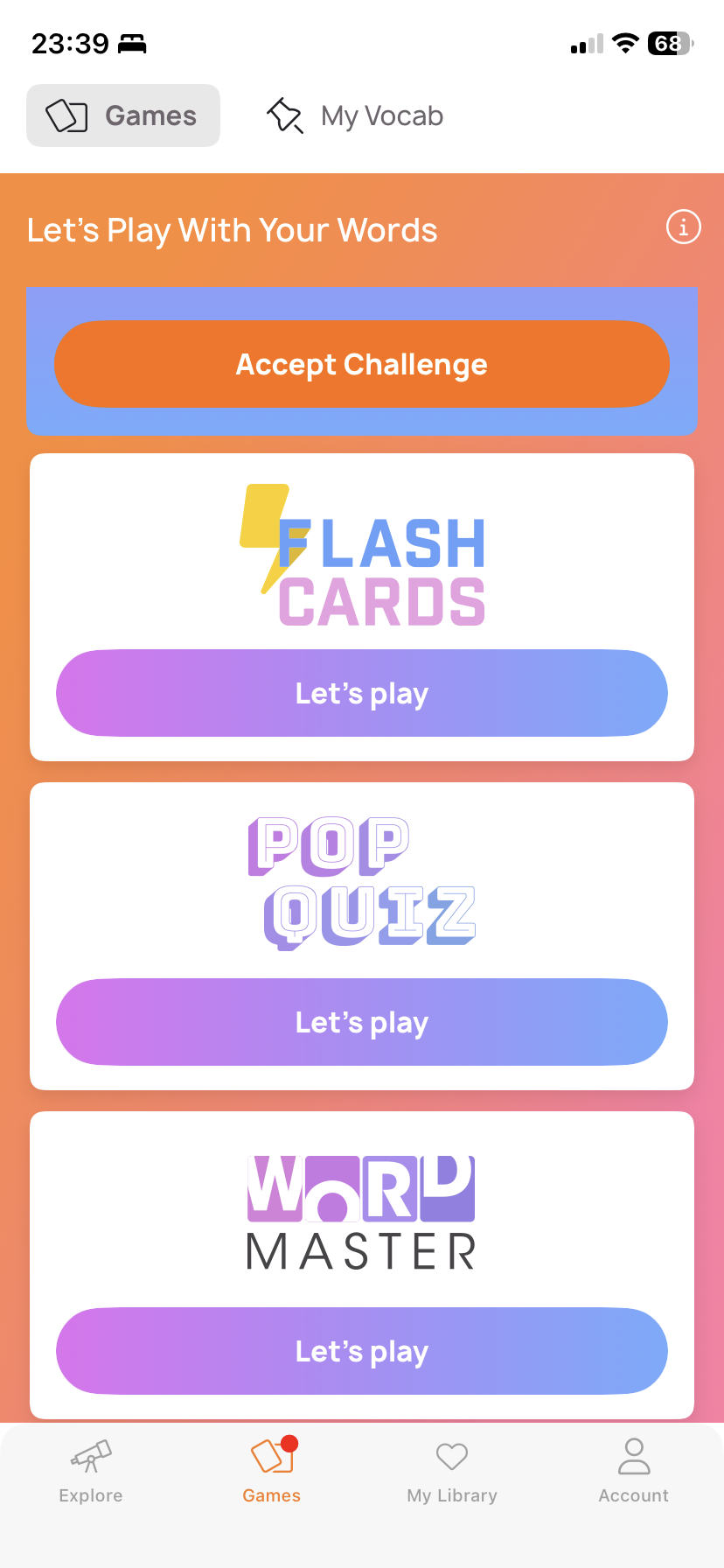
You can also see all your new words in a list, and review them with games and quizzes.

There are several different options for ‘games’, but they are basically all variations on flashcards and matching activities using the vocab you’ve looked up in your shows.
How to use Lingopie to learn Japanese
There are various ways you could study with Lingopie.
For example, if you want to actively work on learning new vocab, you can go sentence by sentence, pausing the video after each line (use the auto-pause feature) and using the built in features to repeat, translate, and look up any new words.
You can use Lingopie for shadowing practice by repeating each line yourself. This can really improve your speaking speed, pronunciation and intonation.
You can challenge your listening skills by turning off all subtitles and just try to follow the dialogue. Or, work on your listening + reading by turning off English and reading along with the Japanese script.
And when you need a break from active studying, you can go into passive mode. Simply enjoy absorbing some content in Japanese and just translate the occasional word you don’t know.
I like this flexibility with Lingopie. You can use a variety of techniques, or just pick the method that works for you.
There is a website version, mobile apps and new smart TV apps (Google TV, Fire TV and Roku).
Personally if I’m in active study mode I find it easiest to use all the features on my laptop. But it’s great to have the other apps for when you want to watch on a different device.
Also, the mobile app is handy for reviewing vocab when you have a spare 5 minutes.
Lingopie pros and cons
Pros:
✅ Good price (less than half the price of FluentU!)
✅ Fun and addictive way to study
✅ Flashcards are great, unknown words are automatically added to decks and it’s easy to review later on the mobile app
✅ Easy to use interface
✅ Great for improving your vocabulary and listening
✅ Great for auditory and visual learners
Cons:
❌ The dictionary could be improved. It often gives overly simple translations with no additional explanations. For example 俺 (ore) is simply translated as ‘I’ with no mention of the nuances of different ways to say ‘I’ in Japanese (although the new ‘explain sentence’ feature goes some way to counteract that).
❌ Sometimes breaks up sentences strangely, grouping particles with words as a set phrase etc – confusing for beginners.
❌ Not a complete course. Lingopie can help you improve your comprehension and vocabulary but it will not teach you grammar, speaking, writing etc. It can be a great way to supplement your learning when combined with a comprehensive textbook or full language course. But you won’t get fluent studying with Lingopie alone.
❌ Not the most effective for complete beginners due to lack of structure and potential overwhelm. Best for intermediate and advanced learners who want more native exposure.
Lingopie vs FluentU
Lingopie is often compared to FluentU because they work on the same premise: you learn a language by watching shows, with interactive subtitles. Both also have flashcards to study new words.
However, there are a few differences:
| Lingopie | FluentU |
| Price: from $6.99 (and unique discount on annual plan available for Team Japanese readers!) | $29.99/month |
| 7 day free trial | 14 day free trial |
| Full length content: mix of films and shows, full series available | Mostly short clips |
| Mostly entertainment content (dramas, anime, movies) | Wider range of ‘real life’ content (ads, speeches, news, music etc) |
| Smaller choice of content at present (but more to be added) | Larger choice of Japanese content (and more added weekly) |
| Slightly harder to navigate/filter content | Easy to filter content by theme, level etc |
| Simple dictionary, single word definitions only | More advanced dictionary with pictures and example sentences |
| Stream on the Lingopie platform only | Extension works with Netflix and YouTube |
| 14 languages available | 10 languages available |
Personally, if I could only sign up to one of these sites I would pick Lingopie. This is because I prefer to watch longer shows and full series (you can really get absorbed, and it feels less like studying!) and they have a great selection of dramas.
I feel like Lingopie is simpler to use and has a focus on watching and enjoying content. FluentU is more focused on learning and drilling new words and phrases.
Also, the price is much lower.
Lingopie pricing
Lingopie have a few different plans: 3 monthly, yearly or lifetime.

The best value is the yearly plan, which is a yearly payment of $83.88 which works out at just $6.99/month!
With yearly or lifetime, you get access to all 14 languages on Lingopie for the same subscription fee. (Currently they have Spanish, French, German, Italian, Russian, Portuguese, Korean, Chinese, Dutch, Polish, Turkish, Greek, Hebrew, and of course Japanese.)
So if you are studying more than one language this is a great deal.
Lingopie free trial
You can get one week’s free trial at Lingopie by signing up here.
Keep in mind that you will need to enter payment info to take the free trial, and you will be automatically charged at the end of the trial period unless you cancel.
So put a reminder in your diary so you don’t forget!
You can easily cancel your trial or subscription under your account settings online.
Conclusion: should you subscribe to Lingopie?
Overall, I have been really impressed with Lingopie and I think it is a fantastic tool for language learners!
But, like any tool, it’s not for everyone. So, is Lingopie any good for you?
✅ YES if…
- You already have a foundation in Japanese and want more exposure to real Japanese materials
- You are looking for a fun and easy way to improve your Japanese (especially vocabulary and listening comprehension)
- You are a visual and/or auditory learner and you are looking for a resource that works with your personal language learning style
- You love watching Japanese shows
- You understand that Lingopie is not a full Japanese course and will not teach you grammar etc.
❌ NO if…
- You’re not interested in Japanese dramas, documentaries or film
- You are looking for free resources (try these instead!)
- You prefer to concentrate on a full Japanese course to learn grammar, reading, writing etc.
- You’re a complete beginner (get the basics down first then come back to Lingopie)
In conclusion, I found that Lingopie is great for extra immersion and introduction to native Japanese materials!
But keep in mind it is not a substitute for an actual course. It will not teach you grammar, writing and so on.
If you are just looking for a way to improve your vocabulary and listening comprehension while enjoying original Japanese content, I recommend you give it a go!

Learn Japanese watching real TV shows and movies, with clickable subtitles for instant translations.
Have you used Lingopie to learn Japanese? How does it compare to other programmes you’ve used? I’d love to hear your experience in the comments!
Lingopie FAQ
Other resources to learn Japanese online
- JapanesePod101 review
- Rocket Japanese review
- FluentU review
- Pimsleur Japanese review
- Huge list of Japanese podcasts
- Huge list of Japanese YouTube channels
- Huge list of site for free Japanese reading practise
📌Pin this for later

Rebecca is the founder of Team Japanese. She spent two years teaching English in Ehime, Japan. Now back in the UK, she spends her time blogging, self-studying Japanese and wrangling a very genki toddler.