
Questions are essential building blocks of language.
Whether you are trying to navigate a new country or want to create an engaging conversation and keep it flowing, knowing how to ask the right questions in Japanese will get you there!
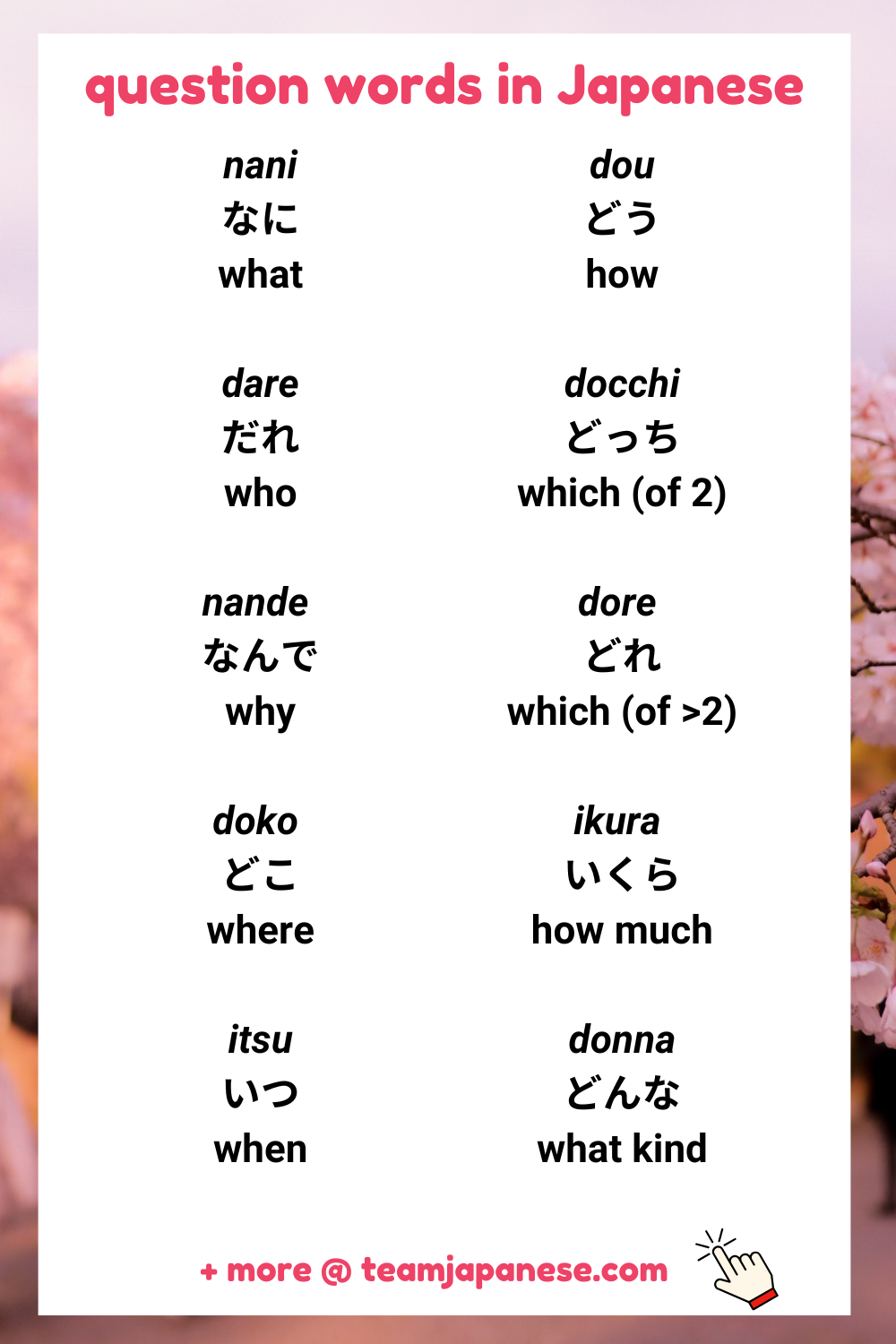
Let’s start with what is sometimes called the ‘5 W’s’ in English: who, what, where, when, why. These question words are used to gather relevant information and allow one to hypothesize and analyze situations.
Dare / donata
だれ / どなた
Who
Dare (だれ) means ‘who’ in Japanese.
This question word is quite versatile: you can use it when posing questions in casual conversations with friends, or even in semi-formal situations such as with coworkers.
That being said, if you are in a more formal situation and want to display a higher level of respect, you should opt for the alternate term, donata (どなた).
Example:
あの人はだれですか
あのひとはだれですか
Ano hito wa dare desu ka
Who is that person?
Nani
何
What
‘What’ in Japanese is represented by the kanji character 何 (なに) and pronounced as nani.
Well, it is sometimes pronounced as nani and sometimes as nan… This depends on the word that follows and/or if it is used in a kanji compound. For example, nanji (何時 / なんじ) means ‘what time’. You will learn when to use each one in context, when you learn new compounds or phrases.
何 is always pronounced as nani when it is a standalone word.
Nani is suitable for use in both informal and formal speech.
Example:
これは何?
これはなに
Kore wa nani
What is this? (Informal)
Example (variation):
これは何ですか
これはなんですか
Kore wa nan desuka
What is this? (Polite)

Naze / nande
なぜ / なんで
Why
Depending on the social situation you find yourself in, there are a few different ways to ask ‘why’ in Japanese.
Naze (なぜ) is the most formal of the terms. If you are posing a question towards an elder or higher up in work, naze is the most respectful way to inquire!
Doushite (どうして) is a step down on the formality ladder, though its meaning is a bit more restrictive. It’s used to ask ‘why’ in the context of ‘for what reason (did you do something)’.
Nande (なんで) is the most casual ‘why’ question word and is perfect for use in conversations with friends and family.
Example:
なぜ遅刻したのですか
なぜちこくしたのですか
Naze chikoku shita no desu ka
Why were you late? (Polite)
Doko / dochira
どこ / どちら
Where
The most common question word for ‘where’ in Japanese is doko (どこ).
You can say doko without it coming off as too informal or impolite. However, if you want to show extra respect to whom you are posing the question, the more formal option is dochira (どちら).
Note that dochira can also mean ‘which’, so context is key!
Example:
トイレはどこですか
といれはどこですか
Toire wa doko desu ka
Where is the toilet?
Itsu
いつ
When
Itsu means ‘when’ in Japanese. Itsu is fine for both casual and formal use, as long as your tone is suitable (i.e opting for plain-form or masu-form verbs).
More question words in Japanese
Dou
どう
How
Dou (どう) means ‘how’ in Japanese, and is just as useful as it is in English!
If you want to be more polite, you should use the term doushite (どうして). As mentioned before, doushite is mainly used to mean ‘why’.
If you are a beginner you shouldn’t worry about mixing the two up. It is a bit of a nuanced difference which becomes clearer with more exposure and advancement in the language!
In any case, check out the example below to see how we might differentiate the two!
To be even more polite, you can use the longer term dono you ni (どのように), which more accurately translates as ‘in what way’.
Example:
Scenario: Your coworker asks you about your new boyfriend:
どうして彼を知るようになったのですか
どうしてかれをしるようになったのですか
Doushite kare wo shiru you ni natta no desu ka
How did you get to know him?
The context tells us that doushite means ‘how’ in this case, as you wouldn’t usually ask a coworker ‘why’ they got to know someone.
Docchi / dore
どっち / どれ
Which
There are two different ways to ask ‘which’, depending on the amount of things you are trying to decipher!
Docchi (どっち) is what you ask when deciding between two things.
Docchi is perfect for use in informal social circumstances, while in a more formal setting, we would use dochira (which can also mean ‘who’ in polite speech!)
In situations when we want to ask about more than two things, the appropriate term would be dore (どれ).
Example:
秋と夏、どっちが好きですか
あきとなつ、どっちがすきですか
Aki to natsu, docchi ga suki desu ka
Autumn or summer, which do you like better?
Ikura
いくら
How much (money)
The question word for ‘how much’ in Japanese is ikura (いくら).
Although in English we can use ‘how much’ in relation to many things including money or amounts of something, ikura is specifically used for money.
Dono gurai
どのぐらい
How many/much
So, if we want to ask ‘how much’ in the non-monetary sense, we use the phrase dono gurai (どのぐらい). It can also be used to inquire about time —‘how long?’ and distance — ‘how far?’
Donna / nanno
どんな / 何の
What kind of
As we have learned, 何 means ‘what’ in Japanese, and paired with the possessive particle no の, we get nanno (何の / なんの) which asks ‘what kind/type of’. Another, and perhaps more commonly used option is donna (どんな).
Asking yes or no questions
Good job!
We just learned a lot of new vocabulary, so for now let’s take a step back to the basics and learn how to ask a simple yes or no question!
You may have noticed in the examples above, that each question ends in か or の rather than a ‘?’.
There are two question particles in Japanese, ka (か) and no (の). Ka is the particle used when speaking in masu-form, while no is used for more casual plain-form speech.
The construction of a yes-or-no question is super easy: you simply add on ka or no to the end of a statement and voila! You don’t even need to punctuate with a question mark as the particle itself marks the question!
Example:
学校に行きました
がっこうにいきました
Gakkou ni ikimashita
I went to school
Question: 学校に行きましたか = Did you go to school?
To answer, ‘yes’ is hai (はい), and ‘no’ is iie (いいえ).
More:
Now you know how to ask questions in Japanese!
Question words form the basis of so many conversations in Japanese! Now you will be able to communicate a little bit easier with people in Japan.
If you want to learn more practical, everyday Japanese, our top recommended online course is JapanesePod101. Try it for free!

JapanesePod101 is our top recommendation to learn Japanese online. We love the fun, current audio lessons and interactive online tools. Sign up for your free lifetime account and see for yourself!
Related posts
📌 Pin this for later!


Hannah is a half Irish/half Japanese girl living in Ireland. Her love for Japan and the Japanese language led her to studying languages and translation in university where she specialised in Japanese. She spent a year studying abroad at Rikkyo University in Tokyo. In her free time, Hannah enjoys using her sewing machine to upcycle clothes and create new pieces!