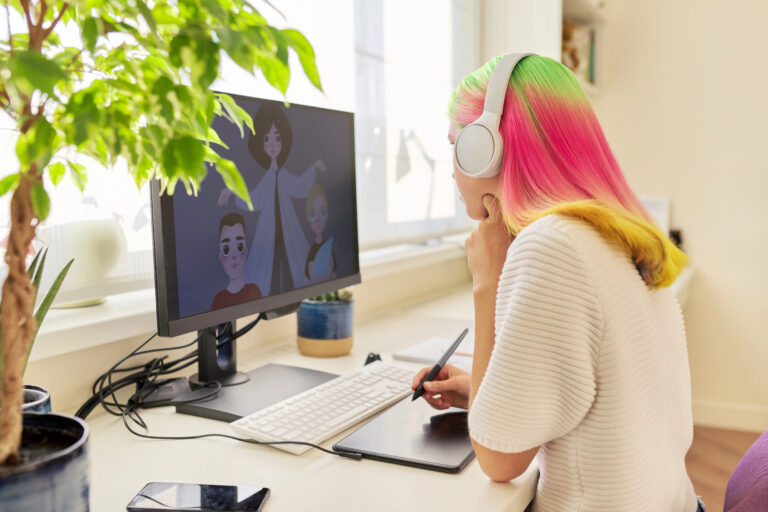
For many learners, anime is their first real exposure to Japanese. And watching anime in the original version is many people’s motivation to start learning Japanese.
It’s no wonder so many people ask if you can learn Japanese watching anime!
Well, anime can be a useful tool for learning Japanese – but only if you know how to use it properly.
Used intentionally, anime can help you get used to how Japanese sounds, improve your listening, and reinforce the vocab and grammar you’re learning elsewhere.
But i’s really important to remember that anime characters don’t always speak like real people, and copying everything you hear can be misleading!
Here’s how I recommend using anime to learn Japanese in a realistic way:
- Can you actually learn Japanese watching anime?
- What you need before learning Japanese with anime
- How to use subtitles when watching anime
- Step-by-step: how to study Japanese with anime
- What types of anime are best for learning Japanese?
- Anime recommendations for learning Japanese
- Using anime as part of your Japanese learning routine
Can you actually learn Japanese watching anime?
Anime can definitely be helpful for learning Japanese, but it has its strengths and limitations.
Let’s be real, you are highly unlikely to become fluent in Japanese from watching anime alone.
Where anime works well is listening exposure.
It helps you get used to the sounds and rhythms of Japanese, as well as reinforcing common sentence patterns.
It can also be extremely motivating!
When you enjoy what you’re watching, you’re far more likely to keep coming back. And there’s nothing like the feeling when you recognise a new word ‘in the wild’, or when you rewatch a favourite episode and realise you can understand so much more this time.
Anime can also help us understand those parts of Japanese that are tied to culture, such as levels of politeness.
Where anime can mislead learners is in how characters speak.
Anime dialogue is often highly stylised or overly emotional. Often, certain speech patterns or slang words are exaggerated to emphasise specific character types (the tough guy, cutesy girl, etc) – but this isn’t how people really talk.
The key thing to remember is that anime works best as a listening and exposure tool.
It can support your Japanese learning, but it shouldn’t be your only method or a substitute for structured study!
But, if you are also studying Japanese from a good textbook or online course (I recommend this one), watching anime can be a great way to improve your listening comprehension and support your learning.
What you need before learning Japanese with anime
Anime works best once you have a basic foundation in Japanese.
You will learn much faster if you can already read hiragana and katakana and recognise a few common words or sentence patterns. Without that, everything tends to blur together.

You’ll want an easy way to note down the new words or phrases that keep coming up, either a notebook or a notes app, or put them straight into an SRS flashcard app like Anki so you can easily review them.
Some optional tools can make things smoother. A Japanese dictionary app is useful for checking meanings as you watch (I use imiwa).
There are also dual-language subtitle tools that make it a lot easier to understand the dialogue and connect the Japanese with English.
Language Reactor is a free tool, Lingopie is a subscription service that has lots of other tools to help you learn like replaying line by line and adding new words to your flashcard deck instantly.

Learn Japanese watching real TV shows and movies, with clickable subtitles for instant translations.
The aim is basically to keep watching anime fun, while giving your brain enough structure to actually learn from it!
How to use subtitles when watching anime
When learning Japanese with anime, subtitles can either help a lot or get in the way, depending on how you use them.
English subtitles are fine in the early stages. They help you follow the story while your ears adjust to how Japanese sounds. You’re still learning, even if you’re not consciously understanding every word.
Japanese subtitles are useful later, but some people prefer to use them in short bursts, because using them for entire episodes can be tiring and distracting. They work well when you rewatch a scene and want to connect what you hear with what you see written.
Try not to pause after every line. Stopping constantly breaks the flow and makes it harder to develop listening intuition.
Also, if you try to translate every single word, it will soon start to feel like a chore. Focus instead on recognising repeated phrases and familiar words.
The goal of subtitles should be to support listening, not replace it with reading.
Step-by-step: how to study Japanese with anime
This is the approach I recommend, that keeps anime enjoyable while helping you learn something useful from it.
Remember, you don’t need to analyse every scene or understand everything that’s said!
1. Choose one anime and stick with it
Staying with the same show helps your ear adjust to the characters’ voices and speaking style. But pick a series with relatively natural dialogue.
Slice-of-life anime or shows set in everyday environments are much easier to learn from than action-heavy, historical or fantasy anime.
2. Watch a short section for the story
Watch five to ten minutes without pausing (audio in Japanese, optional subtitles in English or Japanese depending on your level).
Focus on the plot, emotions, and general flow of the conversation. At this stage, understanding everything is not the goal.
3. Rewatch and listen more actively
Go back and rewatch the same section. Listen for repeated phrases, common reactions, and how sentences end.
Absorbing these patterns can be more useful than trying to memorise individual words.
4. Pick a few useful words or expressions
Choose only a small number of items to look up/note down, that you feel you will actually benefit from learning. Everyday reaction expressions, short phrases, and verbs you hear more than once are ideal.
Remember, you do not need to translate every word or you’ll overwhelm yourself and suck all the joy out of anime!
Tools that allow line-by-line replay or clickable subtitles, such as LingoPie, can make this easier, but they’re optional.
5. Say a few lines out loud
Repeat short lines, copying the rhythm and tone rather than aiming for perfect pronunciation. Even two or three sentences is enough to build confidence and improve your speaking fluency.
6. Save review for later
If you want to review vocabulary, do it separately from watching. Keep anime time relaxed and focused on listening.
Save your new words list to review later that day or the next. This will also help your recall.
What types of anime are best for learning Japanese?
Not all anime is equally useful for learning Japanese. The type of show you choose makes a big difference to how much you’ll actually pick up.
Slice-of-life anime is generally the most learner-friendly. These shows focus on everyday situations and relationships, which means you’ll hear more practical vocabulary and natural language.
Anime set in schools, workplaces, or family settings are good.
Repeated locations and situations lead to repeated language, which makes it easier for your brain to recognise and remember phrases over time.
Action, fantasy or historical anime is usually harder to understand, especially early on. Also, this is where you have to be especially careful about accidentally learning unnatural Japanese. Do you really want to be speaking Japanese like a samurai from the 17th century? (Actually… that might be pretty cool!)
Slower-paced shows obviously work better than fast, chaotic ones. Calm dialogue and breathing space between lines make listening far less tiring.
As a general rule, if the characters spend more time talking about daily life than shouting attack names, it’s probably a better choice for learning!
Anime recommendations for learning Japanese
Obviously there are endless different anime out there, and if you already have a favourite, why not start with that!
But if you’re looking for a starting place, here are some I recommend that have fairly beginner-friendly language and are also fairly easy to find online (Netflix/Crunchyroll):
Beginner-friendly anime series
- Shirokuma Cafe (しろくまカフェ)
Very gentle slice-of-life. Slow pace, clear pronunciation, lots of everyday conversation and repetition. - Rilakkuma and Kaoru (リラックマとカオルさん)
Calm, natural dialogue. Short episodes, everyday adult Japanese, very listenable. - Non Non Biyori (のんのんびより)
Slow-paced slice-of-life set in rural Japan. Natural speech, everyday vocabulary, plenty of pauses. - Doraemon (ドラえもん)
A Japanese kids’ classic with simple sentence structures and repeated language. Excellent for recognising basic patterns. - Barakamon (ばらかもん)
Relaxed rural setting, slice-of-life with lots of casual conversation.
Good for progression (still learner-friendly)
- Aggretsuko (アグレッシブ烈子)
Everyday workplace Japanese mixed with casual speech. Faster than beginner picks but very relevant. - March Comes in Like a Lion (3月のライオン)
Slower pacing, thoughtful dialogue, emotional but realistic speech patterns. - The Way of the Househusband (極主夫道)
Short episodes, clear sentence delivery, exaggerated tone but very repetitive language. - Blue Period (ブルーピリオド)
Natural teenage and young adult speech. More complex vocabulary, good once listening stamina improves.
Several of the Ghibli movies work well for listening practice too – but not all of them! See my recommendations here.
Also, you can check out this site which ranks anime by difficulty level and lets you know how many unique words they use and other stats.
Using anime as part of your Japanese learning routine
Anime can definitely support your Japanese learning – when you use it intentionally!
You don’t need to understand everything or copy every line. Focus on listening, repetition, and absorbing the sounds and patterns of Japanese.
Short, regular sessions with the same series work best. Over time, recognition and understanding will build naturally.
Consistency and enjoyment matter most. Don’t let it turn into a chore or suck the fun out of anime! Use other Japanese resources alongside, and enjoy anime for itself – with additional benefits for your Japanese comprehension!
Do you have any anime recommendations for studying Japanese? Please share them in the comments!
Learn Japanese watching real TV shows and movies, with clickable subtitles for instant translations.
Related posts
- How to Learn Japanese With Netflix [What to Watch and How to Study]
- 17 Japanese Anime Words All Fans Must Know
📌Pin this for later


Rebecca is the founder of Team Japanese. She spent two years teaching English in Ehime, Japan. Now back in the UK, she spends her time blogging, self-studying Japanese and wrangling a very genki toddler.