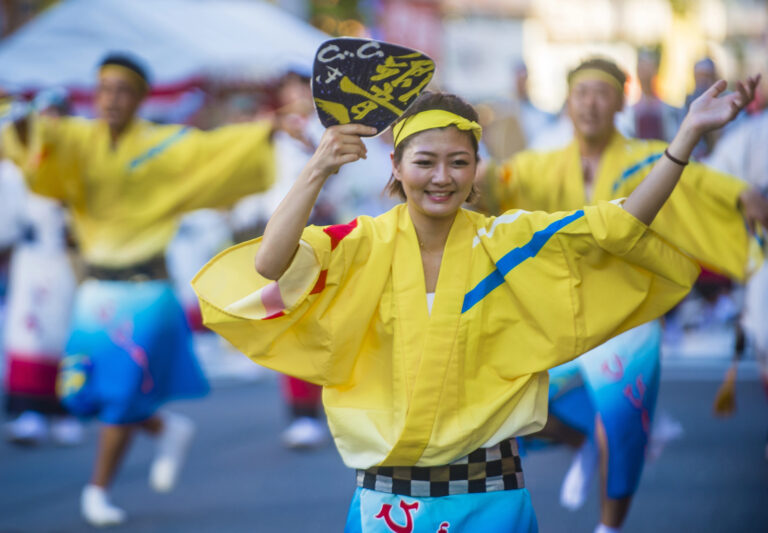
What to Expect at a Japanese Summer Festival

Team Japanese uses affiliate links. That means that if you purchase something through a link on this site, we may earn a commission (at no extra cost to you).

It’s not truly a Japanese summer without summer festivals, or natsu matsuri (夏祭り / なつまつり) as they’re known in Japanese!

Matsuri take place year round, from the Sapporo Snow Festival in Hokkaido in winter to the Niihama Taiko (drum) Festival in autumn. But the peak time for Japanese festivals is summer!

Summer festivals are generally held between Japan’s hot and humid months of June to August. Despite this heat, these festivals can draw thousands of people in from far and wide to come and join in on the fun!

What are Japanese summer festivals?

Summer festivals are community celebrations, which have been a tradition in Japan for generations.

It’s an event of great enjoyment, where people of all ages come together to enjoy food, performances and cultural customs.

Three people wearing patterned shirts play large traditional Japanese taiko drums outdoors, celebrating Japanese Summer Festival traditions with a red and white striped banner and trees in the background.

Many matsuri are steeped in Shinto or Buddhist practices and can center around various concepts such as to honour ancestors or gods, pray for good harvests or to celebrate important historical events.

Some can be on the more calm, lowkey side while others are definitely bigger, more energetic and loud!

It’s a fun outing for young families, with there being plenty of yummy desserts and games to play.

Two people stand in front of a street stall at a Japanese summer festival, admiring colorful bags of cotton candy featuring various cartoon characters.

As kids grow older, it becomes a much anticipated hang out day with friends and even a romantic date activity!

When do Japanese summer festivals take place? 

Natsu matsuri tend to take place from late June through to August. Some festivals take place on the same date each year, while others do not have fixed dates and would depend on the calendar of that year.

If there’s a festival that you want to go and experience, it would be a good idea to check the dates beforehand.

Smaller, more local matsuri tend to be a one-day event while the larger, more famous matsuri can span over several days. 

What happens at a Japanese summer festival?

Food

One of the first things you will see, or perhaps smell, when arriving at a matsuri is the food stalls. These are called yatai in Japanese.

Two people cook and serve food at a Japanese street food stall at a summer festival, grilling yakitori skewers and yakisoba noodles on flat griddles with a price sign in front.
Japanese festival food stall selling yakitori skewers and yakisoba noodles.

They sell all kinds of Japanese street food – think takoyaki (fried octopus balls), yakisoba (fried noodles) and karaage (fried chicken).

A person uses chopsticks to place freshly cooked takoyaki balls into a wooden serving tray at a takoyaki stand.
Making takoyaki, a typical Japanese street food served at festivals.

We also can’t forget about the sweet treats like tanghulu, daifuku mochi and a staple of natsu matsuri: shaved ice!

At a Japanese Summer Festival, a person pours green syrup over a cup of shaved ice from a dispenser at an outdoor stand.
Kakigoori (shaved ice with flavoured syrup) is a welcome treat at hot summer festivals!

Games

Many summer festivals are even equipped with a games area, where you can scoop goldfish or shoot at targets to win prizes.

Here are some popular Japanese festival games:

Children gather around a pink inflatable pool, using small bowls and scoops to collect colorful floating beads.
Bouncing ball scooping (sūpā bōru sukui): collect as many bouncy balls as you can from the water with a paper scoop. Image: スーパーボールすくい by YOICHI NAKANISHI, shared under licence CC BY 2.0
Children and adults stand at a carnival-style shooting game booth with toy rifles and prizes displayed on red shelves.
Target shooting (shateki): shoot down the prize with a cork gun to win it. Image: katorisi, CC BY 3.0, via Wikimedia Commons
Children select colorful floating balls from a water-filled tray at a festival booth, with adults and other kids standing nearby in the background.
Water ballon fishing (yōyō tsuri): hook the floating balloons. MIKI Yoshihito from Sapporo City, Hokkaido, Japan, CC BY 2.0, via Wikimedia Commons

Performances

Depending on the festival, there may be dance performances, drumming performances, live music and parades.

The parades often feature elaborate floats made by the locals and mini portable shrines (mikoshi) carried by the event participants.

A group of children in traditional Japanese summer festival clothing carry a decorated portable shrine (mikoshi) during a festival parade, with adults supervising nearby.
Small mikoshi carried by children. Image: 世書 名付, CC BY 2.0, via Wikimedia Commons

Clothing

As for the natsu matsuri dress code, you can of course go in your everyday clothes, but it is also super common to wear a yukata, a lightweight summer kimono!

Two people wearing floral yukatas walk together at a Japanese summer festival, with food stalls and colorful decorations visible in the background.

It’s fun to dress up with your friends or family to make the occasion feel even more special.

Fireworks

The best summer festivals (in my opinion) end with a fireworks show! This is usually the highlight of the day’s celebration, and can draw massive crowds of people looking forward to catching a glimpse of these ‘fire flowers’, aka hanabi, light up the summer night’s sky.

Fireworks light up the night sky above a lake, their reflections shimmering on the water with a snow-capped mount Fuji and sparkling city lights in the background.

I mean, doesn’t that just sound so perfect?! No wonder summer festivals make such an ideal date outing!

Some famous summer festivals in Japan

Gion Matsuri

Perhaps the most famous and largest summer festival in Japan is the Gion Festival. The Gion Festival, or Gion Matsuri, takes place each year in July in Japan’s historical capital of Kyoto. The festival actually takes place over the whole month of July!

Over the course of the month, there are many little events and activities to partake in such as the food stalls and games mentioned previously.

During July 10th to July 14th, visitors can flock to downtown Kyoto and see the wooden floats being built in real time (impressively, without any nails!)

Although, it must be said that the grand procession of floats which takes place yearly on July 17th is definitely the must-see event. These floats are called yamaboko. They are pulled by hand and some of them can be up to 25 metres tall!

The Gion Festival was started by the people of Kyoto in 869 during a time of despair due to an epidemic. The aim of holding this festival was to ask for god’s protection. There is a reason it is still so beloved to this day, the vibrant atmosphere is definitely worth experiencing if you have the chance!

Nebuta Matsuri

Nebuta Matsuri is held in Aomori prefecture and spans from August 2nd to August 7th.

Nebuta Festival is known as the lantern festival and is characterised by its giant illuminated floats which usually carry depictions of stories or beloved characters. Each night, the huge lantern floats are paraded in downtown Aomori.

Within the procession you can see traditional Japanese taiko drummers, flute players and dancers. These performers encourage the audience to dance along with them, making for a very energetic event! 

On the final night, the procession is held during the daytime. In the evening, the best Nebuta floats are chosen to be ferried out into Aomori Bay and a firework show is held to end the festival with a bang! 

Like the Gion Festival, you can also view the floats before the parades. You can see how they are maintained, prepared and there are even exhibition spaces which display floats from previous years! They are really impressive and intricate handmade works of art.

Tenjin Matsuri

Tenjin Matsuri is held in Osaka on July 24th and 25th. It is the festival of Osaka’s Tenmangu Shrine, dedicated to Sugawara no Michizane, a scholar and poet from the 9th to 10th century, who is now revered as ‘Tenjin’, the deity of academics. 

The first day is more chill, involving some shrine rituals/ceremonies, traditional performances and preparations for the procession of the 25th. 

On the afternoon of the 25th, the land procession first takes place. Participants in historical costumes flock to parade through Osaka. In the evening, the parade then moves from land to water.

Participants carrying the sacred objects and representatives of the shrine board the decorated boats and the river procession begins. 

The community spirit to be felt is incredible, and it is made all the more beautiful by the closing fireworks display, sparkling in the river’s reflection.

Japanese summer festival vocabulary

EnglishKanjiHiraganaRomaji
Summer festival夏祭りなつまつりnatsu matsuri
Casual kimono浴衣ゆかたyukata
Food stall屋台やたいyatai
Portable shrineお神輿おみこしomikoshi
Traditional Japanese drums太鼓たいこtaiko
Traditional Japanese dance踊りおどりodori
Shaved iceかき氷かきごおりkakigoori
Festival float山車だしdashi
Gion Matsuri Float山鉾やまぼこyamaboko

Related posts

Want to learn Japanese?
JapanesePod101

JapanesePod101 is our top recommendation to learn Japanese online. We love the fun, current audio lessons and interactive online tools. Sign up for your free lifetime account and see for yourself!


Join for free!
We earn a commission if you make a purchase, at no extra cost to you.

Hannah Stafford

Hannah is a half Irish/half Japanese girl living in Ireland. Her love for Japan and the Japanese language led her to studying languages and translation in university where she specialised in Japanese. She spent a year studying abroad at Rikkyo University in Tokyo. In her free time, Hannah enjoys using her sewing machine to upcycle clothes and create new pieces!

Leave a Comment

I accept the Privacy Policy

This site uses Akismet to reduce spam. Learn how your comment data is processed.