July in Japan: Star Festival and Summer Fun

Team Japanese uses affiliate links. That means that if you purchase something through a link on this site, we may earn a commission (at no extra cost to you).

July in Japan marks the real start of summer.

The rainy season comes to an end, temperatures rise, and the country goes into festival mode!

Look out for local fireworks festivals and people dressing in yukata.

Whether you’re travelling or enjoying Japanese culture from home, July is full of colour and tradition! Here are some ways to celebrate:

Festivals and events in July

Tanabata

Tanabata, the Star Festival, is celebrated on 7 July and is based on a well-known folk tale.

The story tells of Orihime, a skilled weaver princess (represented by the star Vega), and Hikoboshi, a cowherd (represented by the star Altair). The two fell in love but neglected their duties, so they were separated by the Milky Way and only allowed to meet once a year on the seventh day of the seventh month.

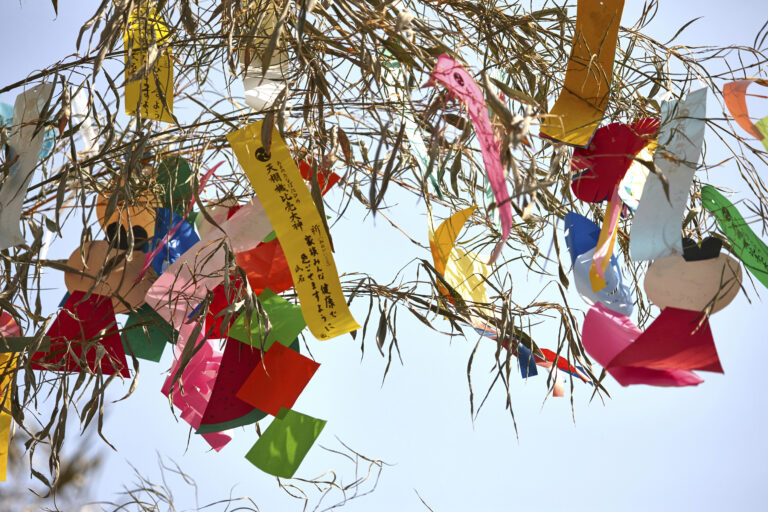
On Tanabata, people write wishes on colourful paper strips called tanzaku and hang them on bamboo branches, hoping their wishes will come true.

Wishes written on Tanzaku, small pieces of paper, and hung on a Japanese wishing tree, located in the Little Tokyo section of Los Angeles, California, photographed at an outdoor mall at night.

You will see shopping streets, schools and homes decorated with these colourful streamers and paper ornaments. The festival has an optimistic and celebratory feel that marks the heart of summer in Japan.

Tanabata is not a national holiday, so expect business as usual if you’re visiting Japan in July.

Marine Day (Umi no Hi)

Marine Day is a national holiday held on the third Monday of July. In 2026, it will fall on 20 July. It’s intended as a day to show gratitude to the ocean and honour Japan’s close relationship with the sea.

Marine Day is a relatively new holiday, so there aren’t really any specific traditions.

Some coastal towns hold events, such as festivals, performances, or community beach clean-ups. Many people head to the coast to enjoy the start of summer holidays. Some aquariums also hold special events on this day. And many people – especially inland – simply enjoy the extra day off!

Crowds of people enjoy swimming, playing, and relaxing on a sandy beach by the water during July in Japan, with umbrellas, tents, and trees in the background.

Gion Matsuri

Gion Matsuri in Kyoto is one of Japan’s most famous festivals and is well known nationwide. It runs throughout the whole month of July.

It originated in 869 as a way to appeal to the gods during a plague outbreak, and has developed into Japan’s biggest festival with large traditional floats, street food and evening celebrations.

Even if you’re not in Kyoto, it’s widely featured in media and summer festival imagery.

Summer fireworks season

July marks the beginning of Japan’s summer fireworks and festival season!

Fireworks festivals take place across the country, often alongside rivers. People gather with friends and family, wearing yukata (light summer kimono) and enjoying food stalls while watching the displays.

People in traditional yukata summer festival clothing stand in line at outdoor food stalls under colorful banners during a lively Japanese summer festival. The sky is partly cloudy and the ground is unpaved.

There are so many different events of all sizes across Japan, so if you are travelling this month, ask around locally to find out what’s going on.

Things to do in Japan in July

July is lively and energetic, especially in the evenings. But be warned – it is HOT!

  • Attend a summer festival and wear a yukata if you have the chance.
  • Watch a fireworks display along a river or waterfront.
  • Visit the beach as outdoor swimming season begins in many areas.
  • Try classic summer foods such as kakigōri shaved ice, cold noodles and grilled festival snacks.
  • Eat eel! It’s believed to help keep your strength up in summer. It’s especially traditional to eat on Midsummer Ox Day, which is on 26 July in 2026.
  • Enjoy evening walks once the heat of the day fades.

What is the weather like in July in Japan

July is hot and increasingly humid across much of Japan.

Tokyo and central regions typically range from 27 to 32°C (80 to 90°F). Northern areas are slightly cooler, while southern regions will feel extremely hot and sticky.

Light, breathable clothing is essential, along with sun protection and plenty of water.

In Japan, people prefer to cover up to protect themselves from the sun. You will find lots of clothing with UV protection in convenience stores, supermarkets and clothing shops like Uniqlo, including hats, scarfs and arm covers.

It’s also very common to carry an umbrella or parasol to protect yourself from the sun.

A small towel is useful, as many people carry one to wipe away sweat. You can also soak it in cold water and wrap it around your neck.

Japanese activities to try at home in July

You can enjoy the feeling of a Japanese summer wherever you are.

Useful Japanese vocabulary for July

  • Tanabata (七夕 / たなばた) – Star Festival
  • tanzaku (短冊 / たんざく) – wish paper
  • take (竹 / たけ) – bamboo
  • Umi no Hi (海の日 / うみのひ) – Marine Day
  • hanabi (花火 / はなび) – fireworks
  • yukata (浴衣 / ゆかた) – summer kimono
  • natsu matsuri (夏祭り / なつまつり) – summer festival
  • kakigōri (かき氷 / かきごおり) – shaved ice
  • atsui (暑い / あつい) – hot
  • natsu (夏 / なつ) – summer

Related posts

Want to learn Japanese?
JapanesePod101

JapanesePod101 is our top recommendation to learn Japanese online. We love the fun, current audio lessons and interactive online tools. Sign up for your free lifetime account and see for yourself!


Join for free!
We earn a commission if you make a purchase, at no extra cost to you.

A woman in a pink kimono holding a red parasol

Rebecca Shiraishi-Miles

Rebecca is the founder of Team Japanese. She spent two years teaching English in Ehime, Japan. Now back in the UK, she spends her time blogging, self-studying Japanese and wrangling a very genki toddler.

Leave a Comment

I accept the Privacy Policy

This site uses Akismet to reduce spam. Learn how your comment data is processed.